


投稿者「kensington」のアーカイブ

新学期 – 学校関連のフレーズ・慣用句

Jaimie’s Blog – Back to school

新学期 – 学校関連のフレーズ・慣用句

September is here and for some of us it means it’s time to go back to school after the holidays.
9月が来て、休暇の後の新学期という方もいらっしゃいますね。

There are quite a few differences between the systems in Japan and the U.K, one is that where I’m from, Scotland ,we don’t have junior high, so we start high school at 12 (an absolutely petrifying experience if I remember correctly) We also begin primary school at 5 and school starts in September not Spring.
日本とイギリスの制度にはかなり多くの違いがあり、私はイギリスのスコットランド出身ですが、そこでは中学校がなく、12歳から高校生になります(私の記憶が確かなら、絶対身がすくんで固まっちゃう体験です)。小学校も5歳からで、学校も春ではなく9月に始まります。

Some of the classes are different too, we have to take religious education for at least 2 years, where we study about other religions and the effect they have on other cultures. French and German are compulsory for 2 years and after that you can drop one or continue both but you must continue a foreign language for at least 4 years. I think British kids start French at the age of 10 now actually.
授業にも違いがあります。私達は最低2年は宗教教育を履修しなければならず、授業では他の宗教や、それが他の文化に及ぼす影響について学びます。フランス語とドイツ語は2年間必修で、その後は1つ履修を止めてもよいし、両方続けてもかまいませんが、少なくとも続けて4年、外国語を1つ学ぶ必要があります。イギリスの子供は、今10歳でフランス語を習い始めていると思います。

We take GCSE exams at 16 in all subjects and after that we drop some of the subjects that aren’t necessary for entering the university we are thinking of and concentrate on some core subjects related to the field we would like to study in our higher education. We don’t really have a university entrance exam as such, your school grades are the basis for the uni you enter. Nobody goes to cram school, in fact I’ve never heard of one near where I used to live.
16歳になると、「一般中等教育修了証」修得のためのテストを、全科目にわたって受け、その後は、大学進学に向けては必要ないと考える科目は履修せず、高等教育で学びたい分野に関連した、主要な科目に的を絞ります。大学入試にあたるものは存在せず、高校での成績が、どの大学に進学するかのめやすとなります。塾に行く子供はおらず、実際のところ、以前自分が住んでいた辺りに塾があったとは聞いたことがありません。

There are very few private schools, the majority of people, around 90 percent ,go to public schools and almost all schools are co-ed.
私立の学校はほとんどなく、大半、約90%が公立の学校に通い、ほとんどの学校は共学です。

Lots of schools don’t have a uniform.
制服は、ないところが多いです。

The canteen food was bad.
食堂の食事はひどいものでした。

Anyway, since it’s back to school for some of you here are few phrases or idioms related to schools.
まあとにかく、これを読まれている皆さんの中には新学期という方もいらっしゃるかということで、学校に関連したのフレーズや慣用句を今回はご用意しました。

school on (to teach, instruct, lecture someone on a subject)
〜を学校する (教える、指導する、[人]にある科目を教え込む)
The first day at work was pretty boring. They just schooled us on the company’s rules.
初出社の日はけっこうつまんなかったな。会社の決まり事ばっかり教えられてね。

cut class (not go to class)
授業を切る (授業をサボる)
I didn’t feel like going to school that day so I cut all my morning classes.
その日、学校に行きたくなかったので、午前中の授業は全部無断欠席しました。

teacher’s pet (someone who does everything to keep the teacher happy)
先生のペット (先生に気に入られることは何でもする人)
I can’t stand that guy! He’s such a teacher’s pet.
あいつ、気に食わないぜ!とんだ先公のお気に入りだよな。

flunk (to fail an exam or course)
落第する(試験で不合格になる、単位を落とす)
I’m going to have to tell my parents I flunked maths again.
数学の試験、また赤点だったって親に言わないといけないだろうなぁ。

hit the books (begin to study hard)
本に当たる (猛勉強に取りかかる)
I’m going to have to hit the books early if I don’t want to flunk maths again.
数学でまた赤点を取りたくないなら、早く勉強頑張らないといけないだろうなぁ。

pass with flying colours (to pass with a good score)
はためく旗とともに通過する (好成績で合格する)
His parents are over the moon because he passed all his exams with flying colours.
彼の親、大喜びしてるわ。彼が見事に全部のテストで立派に合格したものだから。

Hope you find those useful.
以上、お役に立てば何よりです。

See you at the next class.
次のレッスンでお会いしましょう。

Jaimie
ジェイミー
イギリスのスラング・その2

Tim’s Blog – British Slang – Part 2

イギリスのスラング・その2

This is the second part of some very usual British slang expressions.

よく使われるイギリスの俗語(ブリティッシュ・スラング)、今回は第2部です。

1. Dodgy

In British slang terms, ‘dodgy’ refers to something wrong, illegal, or just plain ‘off’, in one way or another.

Ex.1  I had a dodgy kebab last night and I don’t feel right.

Ex.2  There’s just something dodgy about him, I wouldn’t trust him.

1. 「いかがわしい」

ブリティッシュ・スラングでは、dodgy は「不審な」「胡散臭い」または単純にいろいろな点で「イケてない」ことを表します。

例1) 前の夜にヘンなケバブ(中東の焼肉料理)食ってさ、何かしっくりしないんだ。

例2) あいつは何か怪しい、信じるわけにはいかん。

2. Rubbish

One very commonly-used British phrase, ‘rubbish’ is used to mean general waste and trash, to also express disbelief in something to the point of ridicule and to describe something as very bad.

Ex.1 I take the rubbish out every Tuesday and Friday.

Ex.2 What? Are you serious? Don’t talk rubbish.

Ex.3 I thought his new film was rubbish.

2. 「クズ」

よく使われるものの1つで、イギリスならではの言い回しです。rubbish はゴミやがらくたを広く意味しますが、ばかにしたくなるほど信用できないということや、非常に悪いということも表します。

例1) ゴミは毎週火曜と金曜に出します。

例2) 何っ?本気かよ?アホなこと言うな。

例3) 彼の新しい映画はほとんどクズだと思う。

3. Brilliant

‘Brilliant’ is not a word exclusively in the British lexicon, but has a very British usage. Specifically, when something is exciting or wonderful, particularly when something is good news, ‘brilliant’ can mean as such.

Ex. You got the job? That’s brilliant!

3. 「すんばらしい」

Brilliant はイギリス英語でのみ使われる言葉ではありませんが、とてもイギリスらしい使い方があります。特に、わくわくすることや素晴らしいこと、とりわけよい知らせがあるときに、brilliant が使えます。

例) 仕事、見つかったの?そりゃすごい!

4. Taking The Piss

Given the British tendency to mock and satirise anything and everything possible, ‘taking the piss’ is in fact one very popular and widely-used British slang term. To ‘take the piss’ means to mock something, parody something, or generally be sarcastic and derisive towards something.

Ex. Jonathan was taking the piss of his boss again last night. It was absolutely brilliant!!

4. 「おちょくり」

できる限りは何でもからかって皮肉る、イギリス人の傾向を考えると、taking the piss は、実際とても人気で広く用いられるブリティッシュ・スラングの1つです。Take the piss は、「ばかにする」「まねっこする」、または一般的に皮肉で嘲笑的であることを意味します。

例) 昨日の夜さ、ジョナサンがまた上司をおちょくっててさ。絶対すんげーぜ!

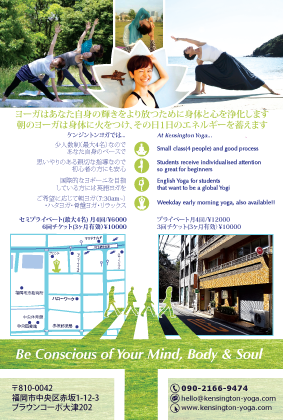
タミヨ先生がデザインした、ケンジントン ヨガ・チラシのコンセプト

 Tamiyo’s Yoga Flyer Concept

 k_yoga_concept_back.png


Back

Again the lotus flower shape was used, this time with a stem, coming from the “ground”.

At the top, photos of the outdoor lessons, representing the morning sky, and in the centre, inside the lotus, the photo of the yogi was introduced.

The flower stem divides the page symmetrically in equal halves, and on each side the text is written in Japanese and English, once the lessons are offered in both languages but also to convey harmony between two different cultures.

At the bottom of the page, where the stem emerges, part of the UK flag was used to convey root, land, and green. Britain is also famous for the beauty of its gardens and green fields

The Beatles (the Fab Four) put Indian culture in vogue back in the 60’s and it is also a connection to the “four features” of Kensington Yoga: small class, individual attention, become a global yogi, and morning classes.

♪ “Sounds of laughter, shades of life are ringing through my open ears

Inciting and inviting me

Limitless undying love which shines around me like a million suns

It calls me on and on, across the universe

Jai Guru Deva OM” ♫

Across the universe – The Beatles

裏

ここでもまた、ハスの花の形を使いましたが、今度は茎が付いており、「地」から生じています。
上の方に配置したのは、屋外レッスンの写真。朝の空をお見せしています。中央の花の中に、ヨガインストラクターの写真を使いました。
花の茎が裏面を、上下左右対称かつ均等に分けています。各パートの文章は日本語と英語の両方で書かれており、レッスンが両方の言語で行われることだけでなく、2つの異なる文化の調和も示しています。
下の方では、茎が現れていますが、イギリス国旗の一部を使って、根、土地、緑を表しました。イギリスは、庭園や青々とした野原の美しさで有名でもあります。
ビートルズ(素晴らしい4人組)は、かつて60年代にインド文化を流行させ、ケンジントン ヨガの「4つの特長」- 少人数クラス、親切な指導、国際的なヨガ実践者にも対応、朝ヨガ – と関連するものでもあります。
♪「明るい笑い声 大地の色彩は 解き放たれた視界の中で 高らかに鳴り響き  誘うように 私を鼓舞する  無限かつ永遠の愛は 何億もの太陽のように 私のまわりに光り輝き  宇宙の果てへと 私を誘う (以上対訳:山本安見)  我らが導師、神に感謝を」♪

アクロス・ザ・ユニバース - ビートルズ


タミヨ先生がデザインした、ケンジントン ヨガ・チラシのコンセプト

Tamiyo’s Yoga Flyer Concept

Briefing

あらまし

Clean, bright, pure

School Philosophy: bright, open environment, individualized attention, English Yoga, morning

清廉、光輝、清純

スクールの理念:明るく開放的な環境、お一人お一人への配慮、英語ヨガ、朝の時間


k_yoga_concept_front.png

Front

The front design was based on the concept of the lotus flower. Representing both yoga and morning.

“The lotus is also a symbol of the centers of consciousness within the body (the chakra centers). The highest chakra, known as the crown chakra or sahasrara chakra, is referred to as a thousand petaled lotus flower.”

http://www.elephantjournal.com/2014/04/the-beatles-yoga-jessie-blackledge/

“The lotus flower has also been a spiritual symbol in Eastern religion for thousands of years. It grows from the bottom of streams and muddy ponds to rise above the water and bloom. It symbolically represents being fully grounded in earth, yet aspiring towards the divine. At night, the lotus flower closes, and sinks below the water, just to resurface again untouched the next day. It is an iconic symbolism of beauty because it lives in the muddy water yet remains unsoiled.”

http://www.yogapoint.com/articles/lotus.htm

The “keep calm” line was used to facilitate the connection between Kensington Eikaiwa school and Kensington Yoga, without having to put Kensington Eikawa school’s logo on the flyer. Although the Eikawa flyer was done in negative (white letter on a dark background) to get attention, and the Kensington Yoga one in positive (letters in a white background) to convey calmness and tranquility, the link between both is clear.

表

表側のデザインは、ハスの花のイメージを基にしました。

ヨガと朝を表現しています。

「ハスの花は、体内にある自意識の中心を、象徴するものでもあります(チャクラの中心。チャクラ:精神的・肉体的エネルギーが宿るとされる場所)。最上部にあるチャクラは、クラウン・チャクラまたはサハスラーラ・チャクラとして知られていますが、1000枚の花びらを持つハスの花として形容されます。」

「ハスの花はまた、東方の宗教において数千年の間、霊的な象徴であり続けています。小川やぬかるんだ池の底から生え、水の上まで伸びて花を咲かせます。地にしっかりと根付いていることだけでなく、神的存在への熱望をも表しています。夜、ハスは花を閉じ、水の下に沈み、そして翌日には再び、そのままきれいに浮かび上がります。泥水の中に生息しているにもかかわらず、けがれのないままでいるがゆえに、美を象徴化したものであるのです。」

「平静を保て」の一文は、ケンジントン英会話とケンジントン ヨガのつながりを、英会話のロゴをチラシに載せることなく表そうとして、使いました。英会話のチラシは、目を引くために、文字の色の方を薄くして(濃い色の表面に白い文字で)仕上げましたが、ヨガのチラシは、文字の色の方を濃くして(白地の上に文字を置いて)、平静さと平穏さを伝えており、両者のつながりははっきりとしています。

TOEIC単語リスト・職業や人に関する重要単語カード No.2

TOEIC単語リスト・職業や人に関する重要単語カード No.2

As we promised before this is the second set of TOEIC words associated with people, necessary for beginner and lower intermediate students.

前回申し上げました通り、今回は、初級者の方、および初級者に近い中級者の方が覚えておくべき、人に関するTOEIC重要単語の第2部をお届けします。

mayor                市長

neighbour           近所の人、隣人

nurse                 看護師

officer                公務員、警察官、将校

parent                親、両親

passenger           乗客、旅客

patient (形)         忍耐強い/患者

person                人、人間

player                 競技者、演奏者

president            大統領、社長、会長

receptionist         受付係

secretary             秘書、書記、長官

staff                    職員、部員

technician            専門家、技術者

Good luck with your TOEIC exams. Remember that if you are living in Fukuoka and you need to increase your TOEIC score Windsor Eikaiwa (in Yakuin) or our affiliate school Kensington Eikaiwa (in Akasaka) can help you.

TOEICテストでのご健闘をお祈りします。福岡にお住まいの方で、TOEICのスコアをアップさせる必要がおありの方、ウィンザー英会話(薬院)、または、提携校のケンジントン英会話(赤坂)が、お手伝い致します。

Riku stars in a Cartoon show

Riku stars in a Cartoon show

When I snapped out of it, Riku had just walked into the living room.

I couldn’t begin to understand what had just happened. For lack of anything better to say, I said “You’ve not just been in that cartoon show by any chance, Riku? Please never do it again because it’s dangerous!” Riku didn’t seem to know what the heck I was talking about.

Now whenever I can, I’m going to keep an eye on my little brother when he watches cartoon shows or he again gets swept up in the fun and turns into a cartoon character. Since this morning, I’ve been having this feeling that some of the big name cartoon characters kids adore all over the world were once real little boys and girls, you know, with big sisters, classmates and smelly sneakers like Riku. If Riku ever turns into a cartoon character, however popular it may be, my parents-especially mom would be devastated. They really love that kid. So I can’t ever tell my parents that Riku starred in the cartoon show. They’d kill me. As a responsible big sister, I can’t let my little brother lose himself in watching a cartoon show and turn into a cartoon character.

snap out 我に返る

keep an eye on …から目を離さない

adore …に憧れる、…が大好きである

turn into …に変化する、…になる

devastated 非常にショックを受け悲しんで、精神的に打ちのめされひどく落ち込んで

Riku stars in a Cartoon show

 Riku stars in a Cartoon show

He wasn’t hurt though, and thanks to the show creators, none of the cartoon characters was. Riku and the gang of cartoons changed into these really cool cowboy and cowgirl outfits complete with large hats and side pistol bags with pistols in them. They entered into these large rooms crowded with people having piles of fun on pachinko machines and tables with colorful wheels on top of them. Riku and his cartoon buddies won stacks of green money. They didn’t have any blue or brown Japanese money in that room. All they had was these green notes and shiny gold coins.

A fight started in one corner of the large room and very quickly spread all over the room. Everyone including Riku and his band of cartoon characters was hitting somebody or something or being hit! The conflict soon spilled over onto the streets. The police quickly arrived to stop the disturbance from turning into a world war. Everyone had pulled out a gun and people who’d run home to get weapons were back with them. “It’s the Asian kids who started it!” said a guy who looked like a rock star with a bloody face. It wasn’t true! Riku wasn’t anywhere near the spot where the fight had broken out. “Where’re they?” said a large police officer with a piggy neck. “Right over there, little scam bags posing like cowboys. Let me smoke ‘em rascals before they cause any further ruin to the town!” shouted a cowgirl in pink boots waving a long pink pistol as a flying boat with FUTSUBISHI AIRBOATS written on it touched down to lift Riku and the cartoon characters to safety. “They’re getting away!” someone shouted. “Who has a big gun I can borrow?” said the large police officer with no neck. “John Wayne!” the crowd shouted. An old man of about seventy-five or older, stepped forward with a very large weapon. He looked pretty buff despite his advanced age, I’d admit. But I wondered what in the world John Wayne a grandfather, was doing with such a weapon in his house. The world can be a very dangerous place, especially in the cartoon shows. “OK John Wayne, said the neckless police officer. Aim and shoot that thing down when you’re ready.” “I don’t need to aim. This baby can shoot god, Satan, the angels, demons and the goblins down from heaven,” said John Wayne and took a shot. In shock, I closed my eyes! John Wayne shot a bunch of large flashing neon signs clean off the city missing the Futsubishi airboat by meters! “Holly dog’s droppings!” the crowd said calling the dog’s droppings by their real name in English (that starts with a fashionable letter of the alphabet called “S”) and they all spat on the asphalt as they watched the flying boat get away, only to hit a large cube of ice placed in its way by a bunch of malicious cartoon aliens with red teeth, fish eyes and chicken legs somewhere over Hokkaido. I think I feinted.

outfit (一揃いの)服装、衣裳

get away 逃げる

a bunch of … …の集団、大勢の…

feinted フェイントをかけられた、陽動作戦をかけられた

仕事関係の慣用句

97737e005c2335bd45df1c73124869c8_s

仕事関係の慣用句

It was a nice long break this summer, 9 whole days off which is almost unheard of!

この夏は長い休暇を気持ちよく過ごせました。まるまる9日間の休みだなんて、今までなかったかもしれません!

I made sure that I did absolutely nothing work related for the entire holidays and much as I enjoy my job, I have to say it was fantastic.

その休みの間は、仕事関係のことは一切しないようにしました。仕事も楽しんでいますが、それと同じくらい素晴らしかったとしか言いようがありませんね。

Unfortunately all good things must come to an end and now it’s back to the grindstone.

あいにく、良いことには全て終わりがつきもので、休みが明けて仕事に戻った今は、ちょっとしんどいですね。

The topic for my next lesson is “At the office” so this time I will show you some work related idioms.

私の次のレッスンですが、テーマは「職場で」です。そこで今回は、仕事関係の慣用句をご紹介しましょう。

Before that though I would like to show you one common mistake that lot’s of people make with the word 残業 .

でもその前に、「残業」という言葉を使うときにありがちな間違いを1つ、申し上げておきたいと思います。

I often hear from my students that they do a lot of overwork but this word actually means 過労 so please be careful.

生徒さん達が、「たくさん ”overwork(働きすぎ)” をする」というのをよく耳にしますが、実は overwork の意味は「過労」なので、ご注意下さいね。

This is how you use them.

「残業」や overwork は、こういうふうに使います。

I am so tired, I did 35 hours overtime last week. Can you believe that?

とっても疲れてるんだ。先週は35時間も残業したんだよ。信じられる?

He regularly did 35 hours a week overtime and eventually his health broke down due to overwork.

彼は日頃から週あたり35時間の残業をし、過労のためついに健康を害した。

Here are a few idioms that we use when talking about work.

ここでは、仕事の話をするときに使う慣用句を、いくつか。

Work yourself to the bone. (Work yourself to the point of exhaustion)

骨の髄まで自分を働かせる。(疲れ果てるまで働く)

I worked myself to the bone trying to get the project finished on time.

企画を締め切りに間に合わせようと、へとへとになって仕事したよ。

Slack off. (be lazy at work)

たるませる。(職場で怠ける)

I can’t stand that guy, he’s always slacking off and seems to get away with it.

あの男には我慢ならないわ、いっつもだらだらしてるし、怒られずにうまいことかわしているようだし。

Be swamped with work. (to have a lot of work to do)

仕事で水没している。(しないといけない仕事がたくさんある)

I don’t think I can make it out tonight, I’m really swamped with work at the moment.

今夜は抜け出せそうにないよ、今本当に仕事に追われてるんだ。

Breathe down your neck. (to feel pressure, usually from your boss)

うるさく、しつこく付きまとう。(圧力を感じる。通常、上司から)

I find it really hard to concentrate on what I’m doing with the boss breathing down my neck all the time.

ひっきりなしにまとわりついてせき立てる上司がいると、自分のやってることに集中するのは本当に大変よ。

Call it a day. (Finish work for the day)

それを1日と呼ぶ。(その日の仕事を終える)

It’s getting late, let’s call it a day and get back into it from tomorrow.

もう遅いので、今日はここまでにして、明日からまた仕事に戻ろう。

Talk shop. (Talk about work)

商売の話をする。(仕事について話す)

Okay, let’s all agree not to talk shop tonight and just have a good time.

はーい、仕事の話は今夜はしないってことにして、とにかく楽しみましょう。

There you go, that’s all for just now, see you at the next lesson and don’t work too hard!

よし、今回はここまで。次のレッスンでお会いしましょう。仕事しすぎないようにね!

Jaimie

ジェイミー

Riku stars in a Cartoon show

Riku stars in a Cartoon show

In the scene he was flying with a bunch of cartoon characters in something that looked like a flying boat. He wasn’t a cartoon, but he spoke in a cartoonish voice. He was having a ton of fun! They flew over this large crack in the ground I think it’s in America or Brazil and ended up in a desert town full of cowboys and Indians running around and riding horses in the dust. The cowboys were shooting pistols in the air and just being disorderly all over the dusty town. I guess cowboys weren’t really cool in the past. In the scene, their behavior was totally unacceptable by any standards of coolness. They were ruining everything. Some of the cartoon characters almost got shot! It was a wrong place to hang out for a Japanese cartoon character and a boy for that matter and that boy was my own brother.

The scene changed suddenly to a city full of lights and buildings full of pachinko and other game machines. Riku and the cartoon characters were about to land into the city when…out of nowhere, a mean-looking cartoon character came riding on a really sleek looking flying boat and BANG! It slammed into Riku’s flying boat. It happened so quickly. I couldn’t get the words “watch out Riku” from my mouth fast enough! I was really terrified! I thought that my brother had been killed in the cartoon show!

a bunch of   大勢の

a ton of   すごく

a desert town   砂漠の町、荒れ果てた町

dust   (舞い上がる)埃

totally unacceptable   全く受け入れられない

hang out   つるむ、ぶらつく、遊ぶ

mean-looking   意地の悪そうな

terrified   おびえた(terrify: …をおびえさせる。terrifiedはその過去分詞形)

日本、夏真っ盛り

Tim’s blog – Midsummer in Japan

日本、夏真っ盛り

The rainy season is over and we are getting deeper into August. It’s officially midsummer and the first thing I talk about with my students when I meet them is how hot and humid it is.

梅雨が明け、8月もたけなわとなってまいりました。本格的な盛夏に入り、生徒の皆さんとお会いしたときに最初に話すことといえば、気温の高さや蒸し暑さのことですね。

The Obon holidays are coming soon and our English schools will be closed for the summer holidays.  Do you like the Obon holidays? Do you go back to your hometown? Personally Obon is my second favourite holiday after Christmas and I know I’m not Japanese or a Buddhist (well I’m not Christian either) but I find that there is something so comforting in the idea of your ancestors spirits coming back to the living world to spend 3 days with you every year. It makes the loss of your loved ones a tiny bit more bearable than it would otherwise be.

もうすぐお盆休みを迎え、教室もしばらくお休みになります。お盆休みは好きですか?里帰りをなさいますか?個人的には、お盆休みはクリスマスの次に大好きです。自分は日本人でもなければ仏教徒でもないとは分かっていますが(クリスチャンでもありませんが)、毎年ご先祖の霊が現世に戻ってきて、そこで3日間を過ごすという考えに、何かしら心なごむものを感じます。大切な人達を亡くした喪失感は堪え難いものですが、お盆がそれをほんの少しですが和らげてくれます。

Now for today, I have picked some words and expressions that are useful when talking about the Japanese summer.

さて今日は、日本の夏を考えるときに役立つ言葉や表現を、いくつかとりあげてみました。(フラッシュカードはこちら)

Rainy season 梅雨

It’s scorching hot! うだるように暑い!

It’s really humid, today! ほんとに蒸し暑いね、今日は!

The heat is unbearable! 暑すぎてどうかなりそう!(暑くて我慢できない!)

cicada せみ

I love the sound of cicadas! せみの鳴き声が大好き!

Shaved ice かき氷

Firework display 花火大会

Did you go to the firework display in Ohori on Aug 1st? 8月1日の大濠花火大会に行きましたか?

Have a barbeque バーベキューをする

Go camping キャンプに行く

Ancestors 先祖

A spirit 魂

In Obon our ancestors’ spirits come back to visit us. お盆には、先祖の魂が私達に会いに戻ってきます。

A tomb お墓、墓石

Clean my ancestors’ tomb 先祖の墓掃除をする

Hold a Buddhist ceremony 法事を営む

Go back to my hometown 帰省する、里帰りする

Visit my grandparents’ house 祖父母の家を訪ねる

Meet my relatives 親戚に会う

How are you going to spend Obon this summer? I hope you have a wonderful time.

今年のお盆はどう過ごされますか?素晴らしいときになりますよう。